
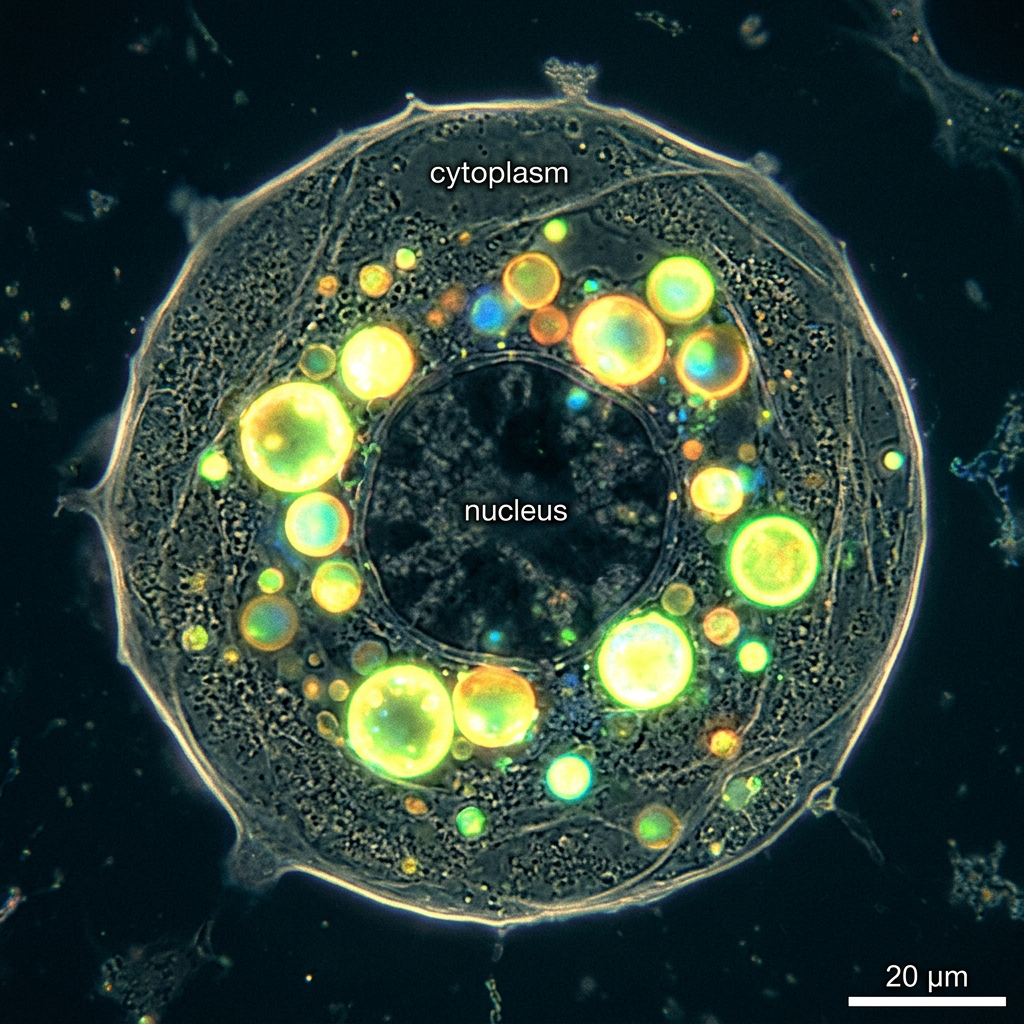
Cells organise themselves through more than membranes. This module introduces phase separation, the process by which proteins and nucleic acids condense into dynamic, membrane‑less droplets that act as functional micro‑environments. These condensates behave like liquid droplets within the cytoplasm or nucleus, forming and dissolving in response to signals, stress, or developmental cues.
You begin by exploring the physical principles behind phase separation. Weak, multivalent interactions between intrinsically disordered regions of proteins allow molecules to cluster together without forming rigid structures. The module shows how these interactions create compartments that concentrate specific molecules while excluding others, enabling rapid, reversible organisation.
You then explore examples of biomolecular condensates: nucleoli assembling ribosomal components, stress granules forming during cellular strain, and transcriptional hubs that gather regulatory proteins. Each example illustrates how condensates regulate gene expression, signalling, and metabolic coordination.
The module also highlights how condensates behave like soft materials, able to fuse, drip, deform, and age. Their physical properties influence reaction rates, molecular accessibility, and cellular responsiveness.
By the end, condensates feel like flexible, adaptive tools, elegant solutions that allow cells to manage complexity without relying solely on membranes.
Buy now on Payhip and get immediate access to the full digital file. Fast, secure checkout with instant delivery.
Leave a Reply