
There is something slightly strange about having lots of projects.
People tend to assume that a project should have a team.
A website should have a company behind it.
A publication should have editors.
A research programme should have researchers.
A business should have departments.
A network of ideas should have meetings, offices, and organisational charts.
But what happens when much of it begins with one person?
Something rather different emerges.
Not necessarily a business.
Not necessarily a collection of hobbies.
Something in between.
An ecosystem.
One person, many directions
From the outside, a collection of unrelated projects can look chaotic.
Why are you writing about science?
Why are you interested in accessible walking?
Why are you exploring campervan travel?
Why are you writing about everyday life?
Why are you building educational resources?
Why are you creating frameworks and practical guides?
The natural assumption is that there must be a missing strategy.
Perhaps everything should be narrowed down.
Perhaps the solution is to choose one thing and abandon the rest.
But that assumes the projects are actually unrelated.
Often, they aren’t.
They simply exist at different levels.
One project might explore a subject.
Another might apply an idea.
Another might explain it.
Another might turn it into something practical.
And another might simply ask what it means in ordinary life.
The connections aren’t always obvious at first.
The traditional career has a shape
There is a familiar model of working life.
You study something.
You get a job.
You specialise.
You gain experience.
You become more senior.
Eventually, you become an expert in a particular field.
There is nothing wrong with that model.
For many people, it works extremely well.
But it isn’t the only way to build useful knowledge.
Some people accumulate depth.
Others accumulate breadth.
And some spend years moving between the two.
They become comfortable enough in several fields to recognise patterns that specialists working entirely within one field might never encounter.
That can be difficult to explain on a CV.
It can be incredibly useful in practice.
The advantage of being slightly out of place
There is an interesting advantage to not belonging completely to one discipline.
You ask questions that insiders sometimes stop asking.
Every field develops assumptions.
People learn what is considered normal.
They learn the accepted terminology.
They learn the usual methods.
They learn which questions are worth asking.
That knowledge is valuable.
But it can also create blind spots.
Someone arriving from another field may look at the same problem and ask:
“Why do you do it like that?”
The question can be irritating.
It can also be revolutionary.
Sometimes the outsider sees something that the insiders have become too accustomed to notice.
The projects start talking
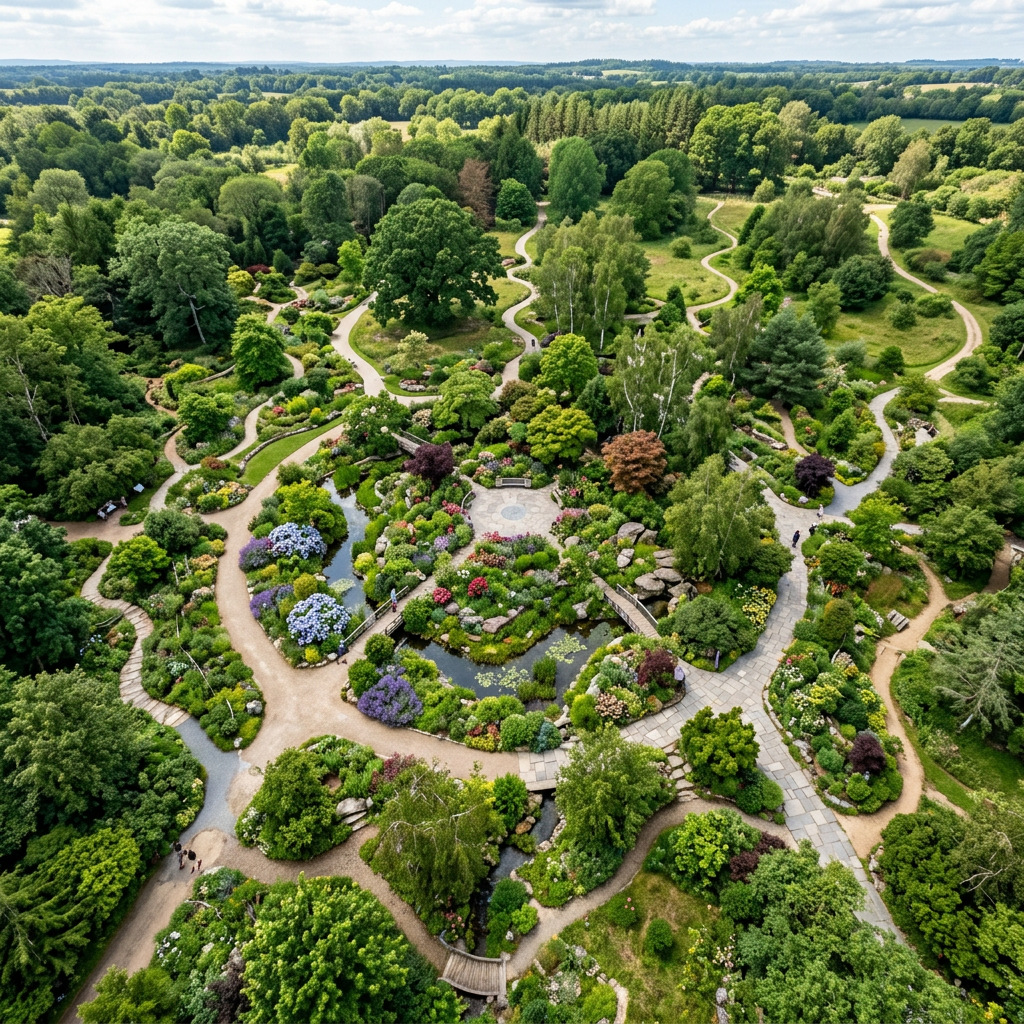
This is where the idea of an ecosystem becomes useful.
Imagine each project as a different part of a larger landscape.
The science project develops one kind of knowledge.
The travel project develops another.
The accessibility project encounters practical problems.
The educational work develops ways of explaining complicated ideas.
The writing explores human behaviour and everyday experience.
None of these needs to become the same thing.
But they can influence one another.
A lesson about accessibility can change how you think about design.
A problem encountered while travelling can raise an engineering question.
A scientific concept can provide a useful way of thinking about an everyday problem.
A writing project can expose an assumption that was invisible in a technical project.
The boundaries become permeable.
Ideas move.
That is when an ecosystem starts becoming more interesting than a collection of individual projects.
It isn’t always efficient
There is a downside.
An ecosystem is not necessarily the most efficient way to work.
There are more things to maintain.
More ideas competing for attention.
More half-finished projects.
More moments when you wonder whether you should simply stop everything and concentrate on one thing.
There is always another sensible argument for simplification.
Sometimes simplification is exactly what is needed.
But not every apparently inefficient activity is wasteful.
Exploration rarely looks efficient from the inside.
The problem with measuring everything
Modern work culture encourages measurement.
Traffic.
Revenue.
Followers.
Conversions.
Productivity.
Output.
Growth.
These numbers can be useful.
But they can also distort what we value.
Imagine spending three months exploring an idea that eventually leads to something genuinely useful.
For most of those three months, the conventional metrics might say that almost nothing happened.
No product.
No significant revenue.
No major audience.
No obvious result.
And yet the thinking may have been essential.
Some of the most valuable work happens before there is anything obvious to measure.
A one-person ecosystem still needs structure
There is a danger in going too far the other way.
Having lots of interests doesn’t mean every idea deserves unlimited attention.
Without some structure, curiosity can become clutter.
The ecosystem needs paths.
Projects need purposes.
Ideas need somewhere to live.
Otherwise, everything becomes a pile of open browser tabs in your head.
The answer isn’t necessarily to eliminate the projects.
It may be to give them distinct roles.
One site explains.
Another explores.
Another provides practical resources.
Another asks broader questions.
Another experiment.
The structure creates freedom.
You know where an idea belongs, even if you don’t yet know where it will lead.
You don’t need to explain everything immediately
One of the strangest pressures of modern work is the expectation that every project should have a perfect explanation from day one.
What is it?
Who is it for?
What is the business model?
What is the five-year plan?
What is the growth strategy?
Again, these questions can be useful.
But sometimes a project begins simply because something is interesting.
That doesn’t make it pointless.
Exploration often needs room before it needs a business plan.
Some projects eventually become businesses.
Some become resources.
Some become experiments.
Some simply generate ideas that feed something else.
Not everything has to justify itself immediately.
The unexpected value of being curious
Curiosity creates connections.
You learn something because it interests you.
Months later, that information becomes useful somewhere completely unexpected.
You meet someone through one project who introduces you to another.
A problem encountered in one area gives you an idea for another.
A skill developed for one purpose becomes useful somewhere else.
This is difficult to plan.
It is one of the reasons breadths can be valuable.
You are effectively creating a larger pool of experiences from which to draw.
There is a difference between distraction and exploration
This distinction matters.
Doing everything because you cannot decide what to do is not the same as deliberately maintaining several projects.
Distraction fragments attention.
Exploration expands possibility.
The difference is intention.
An ecosystem works when the different parts have some relationship to the whole.
They don’t have to be directly connected.
They simply need to contribute to a broader direction.
The ecosystem can grow slowly
There is another advantage.
A one-person ecosystem doesn’t have to scale at the speed of a conventional organisation.
It can grow organically.
One useful article becomes ten.
Ten articles become a guide.
The guide becomes a resource.
The resource suggests another project.
The project generates new questions.
The questions lead somewhere else.
There is no requirement for everything to happen at once.
That can be liberating.
Perhaps the strange part is that it isn’t so strange
Most people are more complicated than their job title suggests.
Someone might be an engineer who loves photography.
A teacher who restores old cars.
A scientist who writes fiction.
A programmer who spends weekends climbing mountains.
A parent who becomes an expert in something because their family needs it.
We contain multiple interests, whether or not our professional lives acknowledge them.
The one-person ecosystem simply makes those connections visible.
So, what is the point?
Perhaps the point isn’t to build as many things as possible.
It isn’t even possible to become an expert in everything.
It is to create enough space for different parts of your knowledge and curiosity to interact.
That interaction can produce something unexpected.
A new idea.
A useful resource.
A better question.
A different way of looking at a familiar problem.
Or simply a deeper understanding of how apparently separate things fit together.
That is the strange life of a one-person ecosystem.
It can look scattered from the outside.
But from the inside, there may be a pattern.
And sometimes you don’t discover the pattern by planning it.
You discover it by building long enough to see what connects.
Leave a Reply